It’s Monday morning. Forty-three new leads landed over the weekend some from MagicBricks, a handful from a Meta ad, a few website enquiries, and two walk-ins your junior forgot to log. Your sales team has time to seriously chase maybe ten of them today.
So which ten?
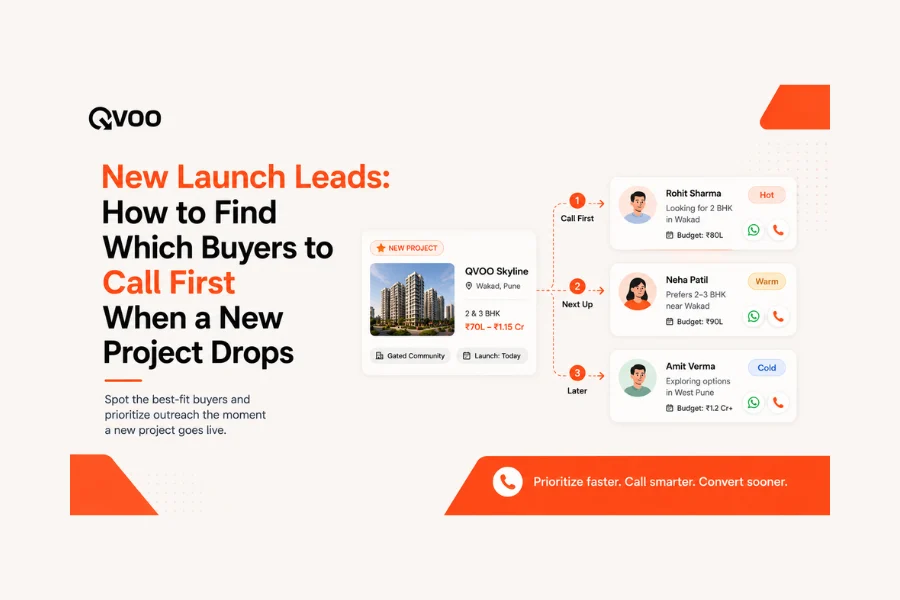
That’s the real problem in Indian real estate right now. Lead generation isn’t the bottleneck anymore. Prioritisation is. Most teams answer the “which ten” question by gut feel, or worse, by whoever called most recently. The buyer who was actually ready to book this week gets a callback on Thursday by which time three other brokers have already shown them a flat.
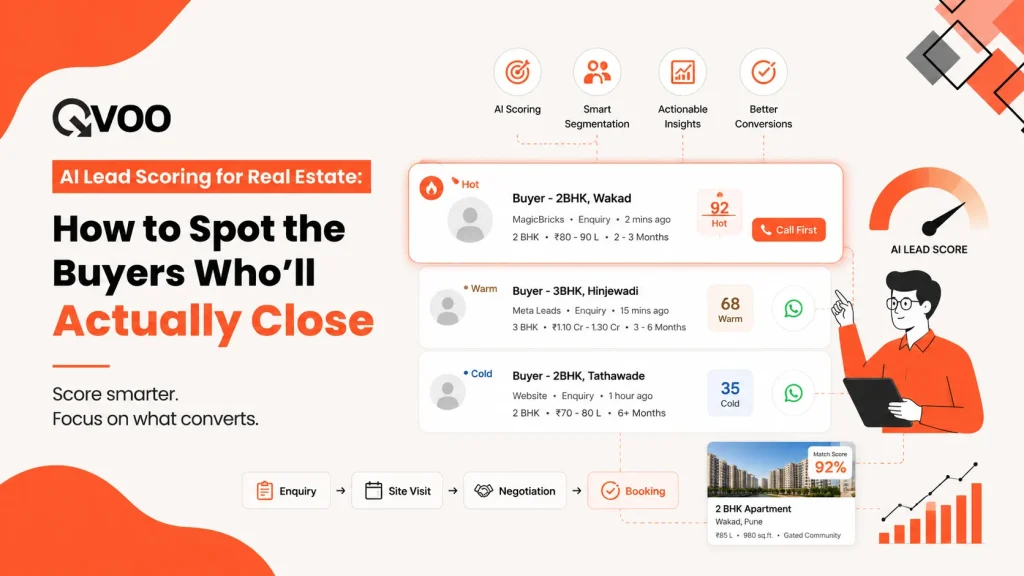
AI lead scoring is how smart teams fix this. Done right, it tells you who to call first, and why. Done wrong, it’s a number on a screen nobody trusts. This guide breaks down what lead scoring really is, the signals that matter in the Indian market, and how to build a system your team will actually use.
What “AI lead scoring” actually means
Strip away the buzz and lead scoring is simple: you give every lead a value based on how likely they are to buy, and you work the high-value ones first.
The “AI” part means the system learns from data instead of relying only on a fixed checklist. It watches how leads behave who replies, who books a site visit, who keeps coming back and uses those patterns to rank new leads. The goal isn’t a clever algorithm for its own sake. The goal is to put your best hour against your best lead.
Think of it like a broker’s instinct, written down and applied consistently across your whole team even on the busy mornings when instinct runs out.
Why Indian brokers can’t afford to guess
The portal model makes prioritisation urgent in a way that’s specific to our market.
When a buyer enquires on a property portal, that enquiry rarely comes to you alone. It’s often distributed to five to ten brokers at the same time. The buyer’s phone starts ringing within minutes and the broker who calls first, with the right property, usually wins the conversation. Speed isn’t a nice-to-have here. It decides who gets the site visit.
Then there’s the leakage problem. A large share of portal and Meta leads never get contacted at all, because they’re buried in someone’s personal WhatsApp or scribbled in a diary. You paid for those leads. They simply die in a chat thread.
Add it up and the picture is clear: too many leads, shared with too many competitors, slipping through too many cracks. A broker who can instantly tell a hot buyer from a tyre-kicker and act in the first few minutes has a structural advantage. That’s what scoring gives you.
The signals that actually predict a sale
You don’t need a data science team to score leads well. You need to track the right signals consistently. These are the ones that matter most for real estate:
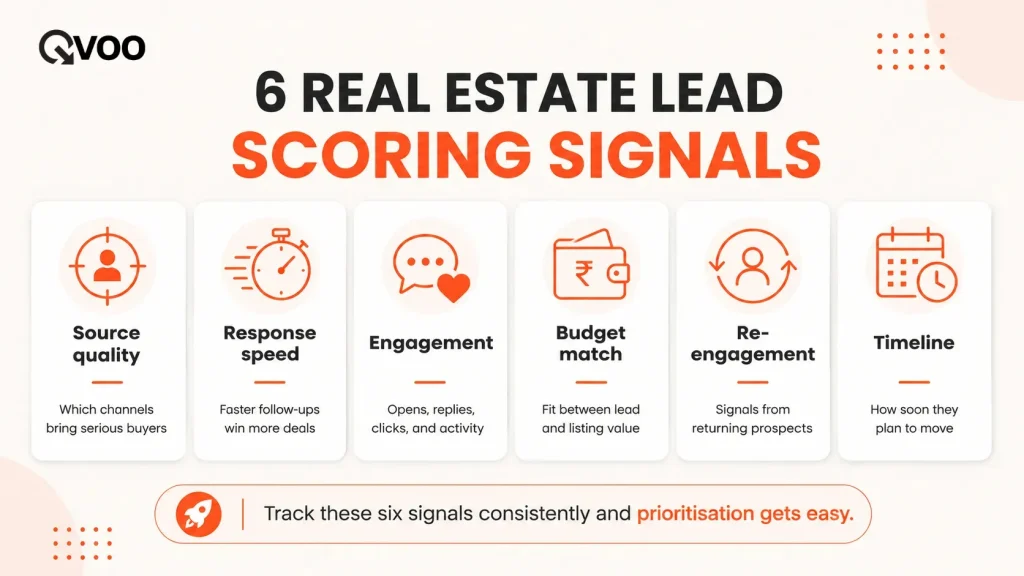
- Source quality. A referral or a website enquiry usually converts better than a cold portal lead that’s been shared ten ways. Where a lead came from is one of the strongest early signals you have so capture it automatically, every time.
- Response speed. This is the big one. Buyers who hear back within the first few minutes are far more likely to engage than those who wait hours. The longer a lead sits, the colder it gets especially when nine other brokers are calling.
- Engagement behaviour. Did they reply to your WhatsApp? Open the brochure? Pick up the call? Ask about a specific tower or locality? Active engagement is the clearest “I’m serious” signal a buyer can give you.
- Budget and requirement match. A lead looking for a 2BHK in your exact micro-market at a price you actually have inventory for is worth more of your time than someone whose budget doesn’t fit anything on your books.
- Re-engagement. A buyer who enquires again a second time, weeks later is telling you something important. Repeat interest is one of the most underrated buying signals in real estate. These leads should jump to the top of your list, not get logged as a “duplicate” and ignored.
- Timeline. Someone planning to buy this quarter deserves more attention than someone “just looking” for next year. Both matter but not today, and not equally.
A simple scoring framework you can start with
You don’t have to launch a complex model on day one. Start with a basic point system your team understands, then let the data sharpen it over time.
Give each lead points across the signals above. For example: a website or referral source earns more than a shared portal lead. A reply within five minutes adds points; no contact after 24 hours subtracts them. A clear budget match adds points. A second enquiry adds a big jump. Sort your list by total score, and your “which ten this morning” question answers itself.
Group the results into three simple buckets your team can act on:
- Hot: Strong source, fast engagement, budget match, ready timeline. Call now, today, personally.
- Warm: Genuine interest but missing a piece maybe unclear budget or slow to reply. Nurture with timely follow-ups and useful information.
- Cold: Low engagement, poor fit, or gone quiet. Keep them in an automated follow-up flow, but don’t burn your best hours here.
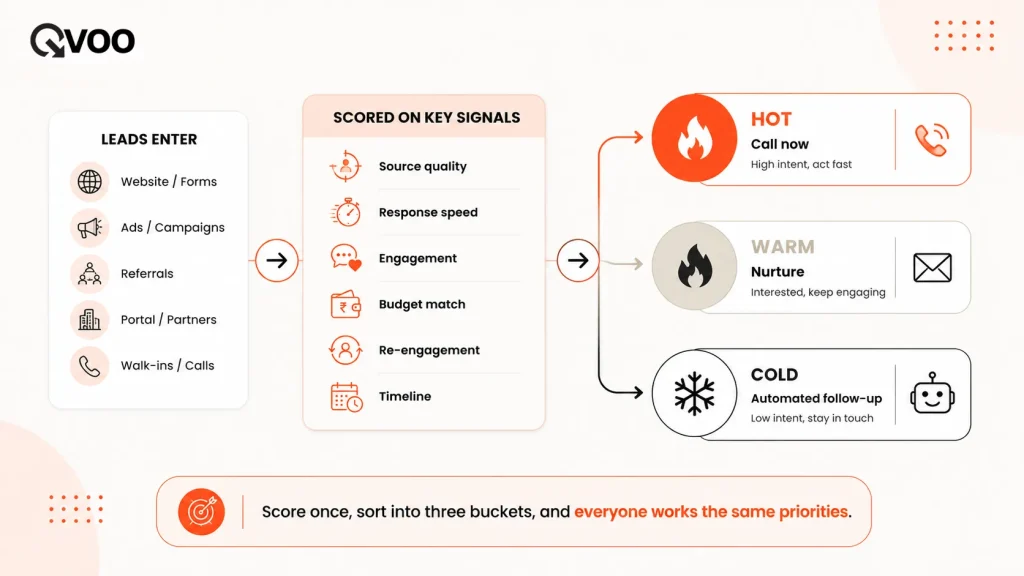
The magic isn’t the maths. It’s that everyone on the team works from the same priorities instead of their own guesswork and nobody forgets to follow up.
Where a CRM turns scoring into a daily habit
A scoring framework on a whiteboard is useless if the data lives in ten different WhatsApp chats. This is exactly where a CRM earns its place by capturing the signals automatically and putting them in front of the right person.
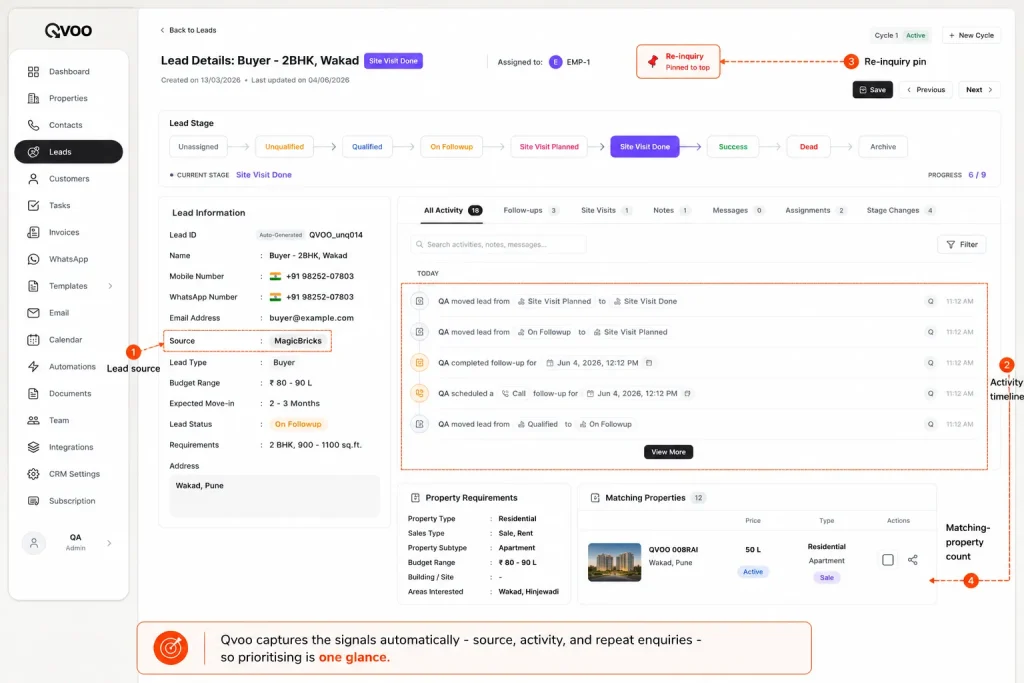
Qvoo CRM currently helps real estate teams manage enquiries, follow-ups, property leads, sales pipeline, and bookings from one place built on a scalable platform with a broader CRM vision for more industries in the future. For lead prioritisation, that means the raw material you need to score leads is already being captured for you:
- Every lead’s source is recorded automatically. Leads flow in from 99acres, MagicBricks, Housing.com, Meta Ads lead forms, Google Ads, and your own website and Qvoo tags where each one came from, so source quality is a fact, not a guess.
- A full activity timeline sits on every lead. Calls, follow-ups, site visits, notes, stage changes the engagement history is right there, so you can see at a glance who’s actually moving and who’s gone quiet.
- Repeat enquiries surface instead of getting lost. When a buyer who’s already in your CRM enquires again, Qvoo flags it as a re-inquiry, alerts the right team members, and pins that lead to the top of the list. That strong “they’re back” signal stops disappearing into a duplicate.
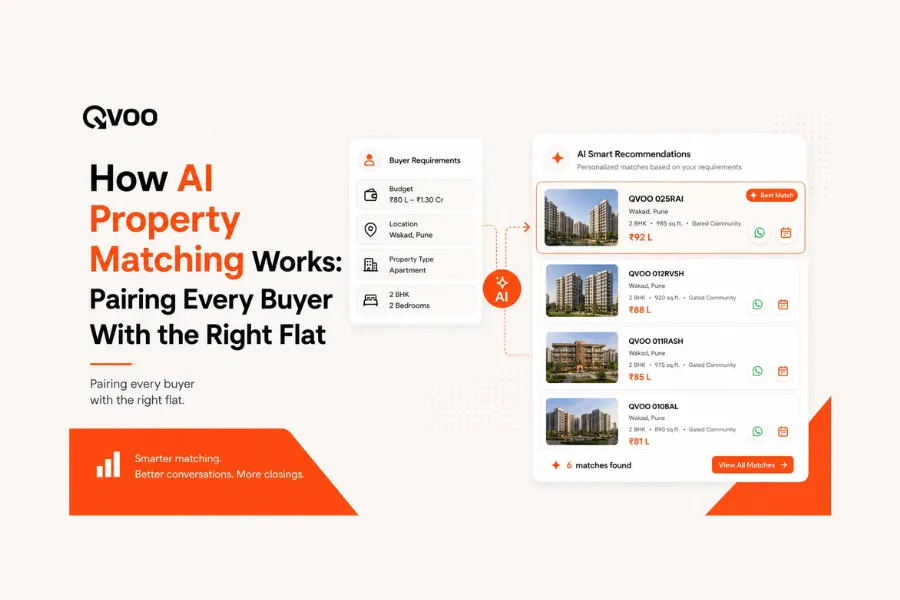
- You see how many of your listings actually fit. Qvoo counts the live properties that match each lead’s budget, type, and location so budget-match scoring is built into the workflow, not done on paper.
- AI property recommendations do the matching for you. Based on what a lead is looking for, Qvoo recommends the properties that fit best, so your team spends time selling the right flat instead of hunting through a spreadsheet.
- Fast follow-up is one tap away. With WhatsApp Business built in, your team can reply to a fresh lead in those crucial first minutes using approved message templates which is exactly when response speed is winning or losing the deal.
Qvoo gives you the signals; your team applies the judgement. That’s an honest, practical version of “AI lead scoring” not a black box that spits out a number nobody trusts, but a clear, shared view of which buyers deserve your time first.
Getting started without overcomplicating it
You don’t need to wait for a perfect system. This week, you can:
- Make sure every lead from every source lands in one place, with its source recorded.
- Agree on three or four signals your team will score: source, response speed, budget match, and re-engagement are a strong start.
- Sort your daily list by those signals and call the hot leads first, fast.
- Review what actually converted after a month, and adjust the weights.
Do that consistently and you’ll feel the difference quickly: fewer leads slipping away, faster first responses, and a team that spends its energy on the buyers most likely to close.
The brokers who win in a crowded portal market aren’t the ones with the most leads. They’re the ones who know every single morning exactly which leads to chase first.
Ready to stop guessing which leads to call? See how Qvoo CRM captures every lead, every source, and every signal in one place. Book a quick demo and put your best hour against your best buyer.
Want to see best options for your Leads?
Explore how QVOO works with your existing sales pipeline.
Frequently asked questions
What is AI lead scoring in real estate?
AI lead scoring ranks your leads by how likely they are to buy, using signals like source, response speed, engagement, budget match, and repeat enquiries. Instead of a fixed checklist, it learns from how your leads actually behave, so your team knows who to call first.
How do I prioritise real estate leads when I get too many?
Score each lead on a few key signals where it came from, how fast and how much they engage, whether their budget fits your inventory, and whether they’ve enquired before. Sort by that score and work the “hot” leads first. A CRM that captures these signals automatically makes this a daily habit instead of a guess.
Which signals matter most for scoring property leads?
Source quality, response speed, engagement behaviour (replies, brochure opens, site-visit requests), budget and requirement match, and re-engagement (a second enquiry). Timeline how soon they plan to buy matters too. Response speed is especially critical when portal leads are shared with many brokers at once.
Why do so many portal leads never convert?
Two reasons. First, portal enquiries are often sent to five to ten brokers simultaneously, so speed decides who wins. Second, a large share of leads never get contacted at all because they sit in personal WhatsApp chats or notebooks instead of a shared system. Capturing every lead in one place fixes the second problem instantly.
Can a CRM score my leads automatically?
A CRM’s real value is capturing the signals you need to prioritise lead source, activity history, repeat enquiries, and matching inventory and surfacing them clearly. Qvoo CRM records each lead’s source, keeps a full activity timeline, flags repeat enquiries and pins them to the top, and shows how many of your listings match each lead, so prioritisation becomes fast and consistent.
How fast should I respond to a new real estate lead?
As fast as you reasonably can ideally within the first few minutes. Buyers who get a quick first response are far more likely to engage, and in a market where the same lead reaches several brokers at once, the first useful reply often wins the site visit.