
You’ve heard it at every event and in every WhatsApp group this year: “Use AI or get left behind.” But you run a real brokerage. You have portal enquiries piling up, site visits to confirm, and a channel partner waiting on a callback. You don’t have time for hype.
So here’s the honest version. This is what AI for real estate brokers genuinely does well in 2026, what it still can’t do, and how to spend your attention on the parts that actually move a deal forward.
First, let’s clear up what “AI” even means for a broker
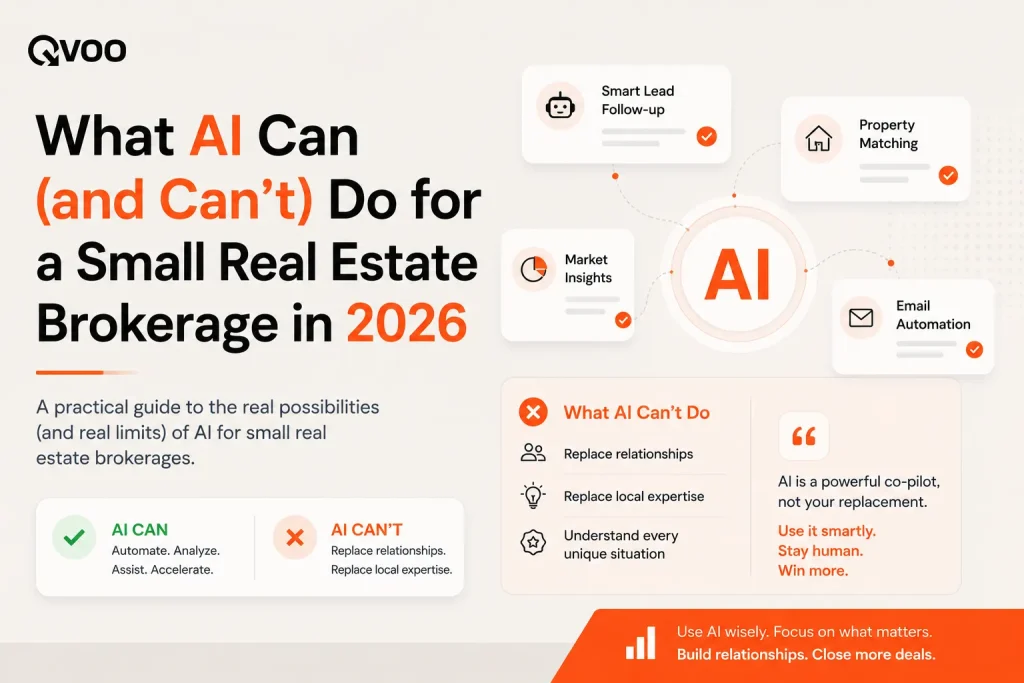
When a tool says “AI,” it usually means one of three simple things: it sorts information faster than you can, it spots patterns across lots of data, or it drafts text for you to send. That’s it. It is not a salesperson. It does not build trust over chai. It does not read a buyer’s hesitation at the third site visit.
Knowing this saves you money. Most brokers don’t need a separate “AI tool.” They need their existing work enquiries, follow-ups, properties, bookings organised in one place so the useful, AI-style help can actually run on top of it. A CRM with everything in one system beats five disconnected apps that each claim to be smart.
What AI for real estate brokers does well today
1. It matches the right property to the right buyer fast
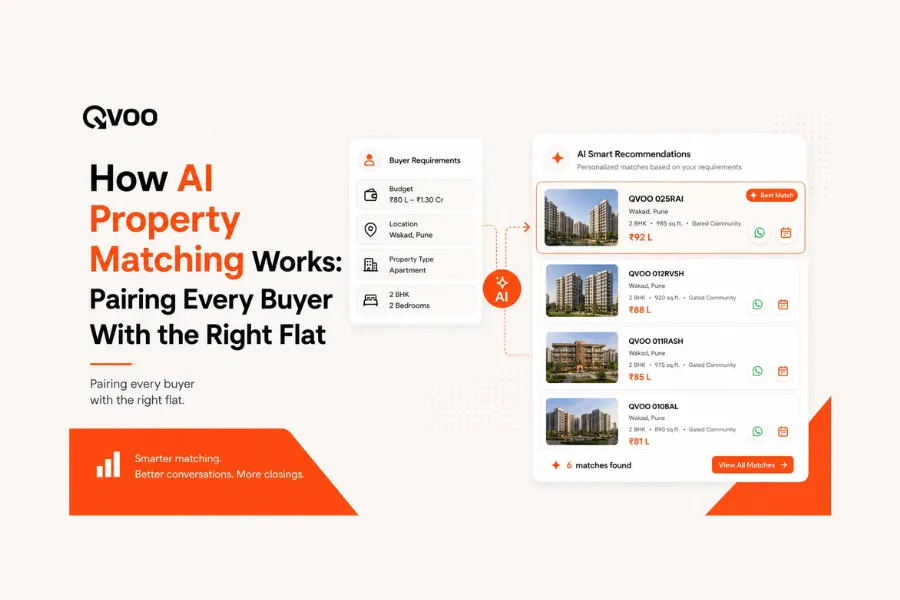
This is the part of AI that earns its keep for a broker. A buyer tells you their budget, location, and configuration. You have dozens or hundreds of listings. Manually scanning your inventory for the right fit is slow, and good matches slip through.
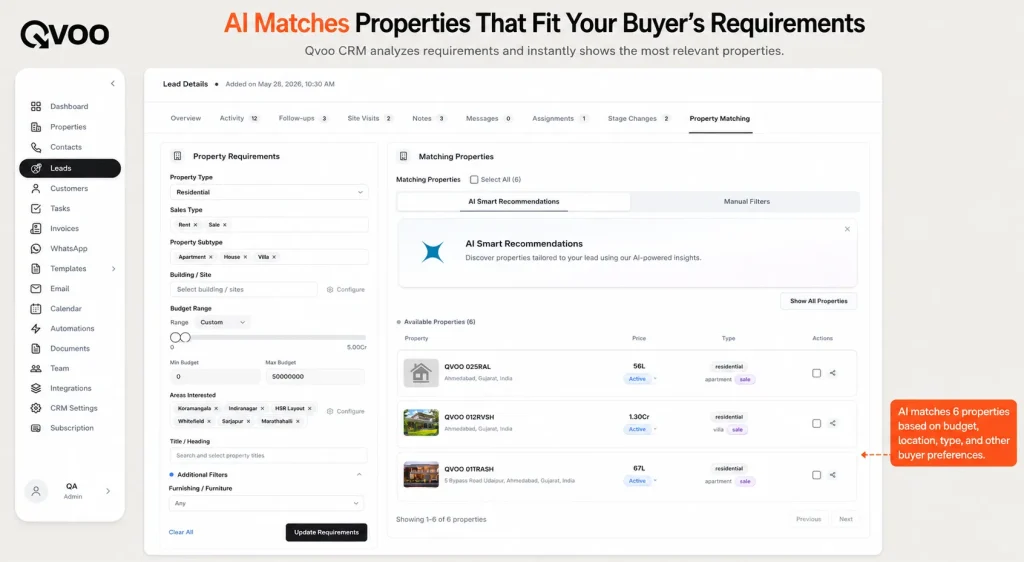
This is exactly where Qvoo CRM helps. When a lead’s requirements are captured budget, locality, 2BHK vs 3BHK, plot vs flat Qvoo matches them against your live property inventory and shows you how many properties actually fit that buyer. From the other direction, open any property and Qvoo shows the leads it matches. You stop guessing and start sending the three right options instead of thirty random ones.
2. It drafts and sends your follow-ups so they actually go out
Most deals aren’t lost on price. They’re lost because nobody followed up. In Indian real estate, a buyer often takes months from first enquiry to booking, and consistency over that stretch is everything.
AI-style automation helps two ways. It can draft a clean follow-up message so you’re not staring at a blank screen, and it can make sure the message actually goes out on time. Qvoo’s WhatsApp Business support lets you send approved templates and bulk updates to leads new inventory, a price revision, a site-visit reminder without typing each one by hand. You stay personal; the system handles the repetition.
3. It tells you where your pipeline is leaking
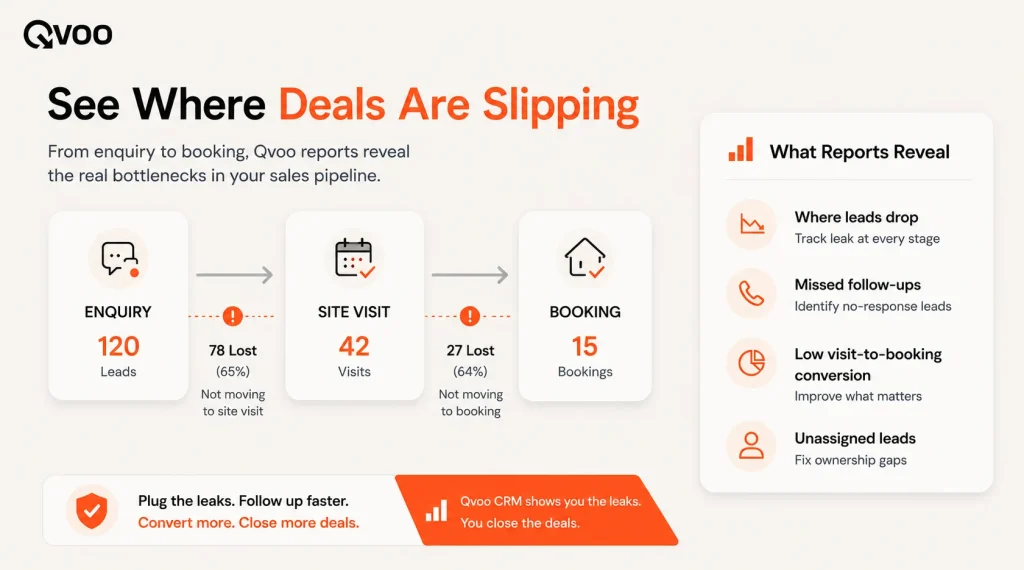
A broker’s instinct is good, but instinct can’t count. AI-style reporting can. It looks across every enquiry, site visit, and booking and shows you the pattern: which source brings buyers who actually close, where leads go cold, which team member’s follow-ups are slipping.
Qvoo’s dashboard and reports turn your day-to-day activity into a clear picture real-time pipeline, property performance, and team activity so you make decisions on numbers, not on the loudest opinion in the room.
4. It captures leads the moment they arrive
Speed wins the buyer. When an enquiry lands on 99acres, MagicBricks, Housing.com, a Meta ad, or your website form, automation can pull it into one place instantly and route it to the right person no copy-pasting from five tabs. Qvoo does this so a lead is in your team’s hands in seconds, not the next morning when it’s already gone cold.
What AI still can’t do (and shouldn’t pretend to)
Here’s the part the hype skips.
It can’t build trust. A family buying their first home is making the biggest decision of their lives. They buy from a person they believe. No model does that for you.
It can’t run the site visit. Reading the room, answering the unasked question, sensing when to push and when to wait that’s craft. AI can remind you to go; it can’t go for you.
It can’t negotiate the real deal. The give-and-take with a builder or a channel partner, the relationship you’ve spent years building that stays human.
It isn’t always right. A match suggestion is a starting point, not gospel. Your judgement on a buyer’s true intent still beats any score. Treat AI output as a smart assistant’s first draft, and keep your hand on the wheel.
The brokers who win in 2026 aren’t the ones who hand everything to a machine. They’re the ones who let the machine handle the sorting, the chasing, and the counting so they have more hours for the conversations that actually close deals. Real estate should be about people, not paperwork.
A simple way to start
You don’t need to overhaul anything. Start small:
- Get every lead source flowing into one place so nothing is captured in WhatsApp, a notebook, and a spreadsheet at the same time.
- Let the system draft and send your routine follow-ups, so consistency stops depending on memory.
- Use match suggestions to send fewer, better property options to each buyer.
- Read one report a week where leads come from, where they stall and fix one thing.
That’s AI working for a brokerage in a way you’ll actually feel, without the buzzwords.
Where Qvoo fits
Qvoo CRM currently helps real estate teams manage enquiries, follow-ups, property leads, sales pipeline, and bookings from one place built on a scalable platform with a broader CRM vision for more industries in the future. Its AI help is deliberately practical: it matches a buyer’s requirements to the properties that fit, surfaces matching leads for each listing, and keeps your follow-ups and reporting honest. No magic claims just less paperwork and more time with people.
If you’ve been wondering whether AI is worth it for a team your size, the answer is yes for the boring, repetitive parts. Keep the human parts human.
Want to see what that looks like for your team? Book a quick Qvoo demo and bring your real workflow we’ll show you exactly where AI helps and where it doesn’t.
Want to scale your Small Business?
Explore QVOO and see how a structured sales can help your small business grow faster.
Frequently Asked Questions
Is AI worth it for a small real estate brokerage?
Yes for the repetitive work. AI for real estate brokers is genuinely useful at capturing leads instantly, drafting and sending follow-ups, matching buyers to the right properties, and showing where your pipeline leaks. It won’t build trust or close the deal for you, so the value is in freeing up your time, not replacing your judgement.
What can AI actually do for real estate lead management?
It can pull enquiries from every source into one place, route them to the right person in seconds, draft consistent follow-up messages, and flag which leads and sources are most likely to convert. In Qvoo, it also matches each lead’s requirements to the properties in your inventory that fit.
Will AI replace real estate brokers in India?
No. AI handles sorting, reminders, and pattern-spotting. The parts that win deals trust, the site visit, negotiation, and long-term relationships with builders and channel partners stay firmly human. The brokers who do best treat AI as an assistant, not a replacement.
Do I need a separate AI tool for my brokerage?
Usually not. You’re better off with one system where your leads, properties, follow-ups, and pipeline already live, so the AI-style help runs on top of organised data. Five disconnected “smart” apps tend to create more work than they save.
How does AI property matching work?
You capture a buyer’s budget, location, and configuration, and the system compares those requirements against your live inventory to show which properties fit and, from a listing, which leads match it. It’s a fast shortlist, not a final decision; you still choose what to send.
Where should a broker start with AI in 2026?
Start by getting every lead source into one place, automate your routine follow-ups, use match suggestions to send fewer and better options, and review one pipeline report a week. Small, practical steps beat a big “AI transformation.”