
A buyer drove across the city, walked the flat, liked the view, and said “let me think about it.” That was three weeks ago. You have not called since. The booking went to another broker who followed up the next morning.
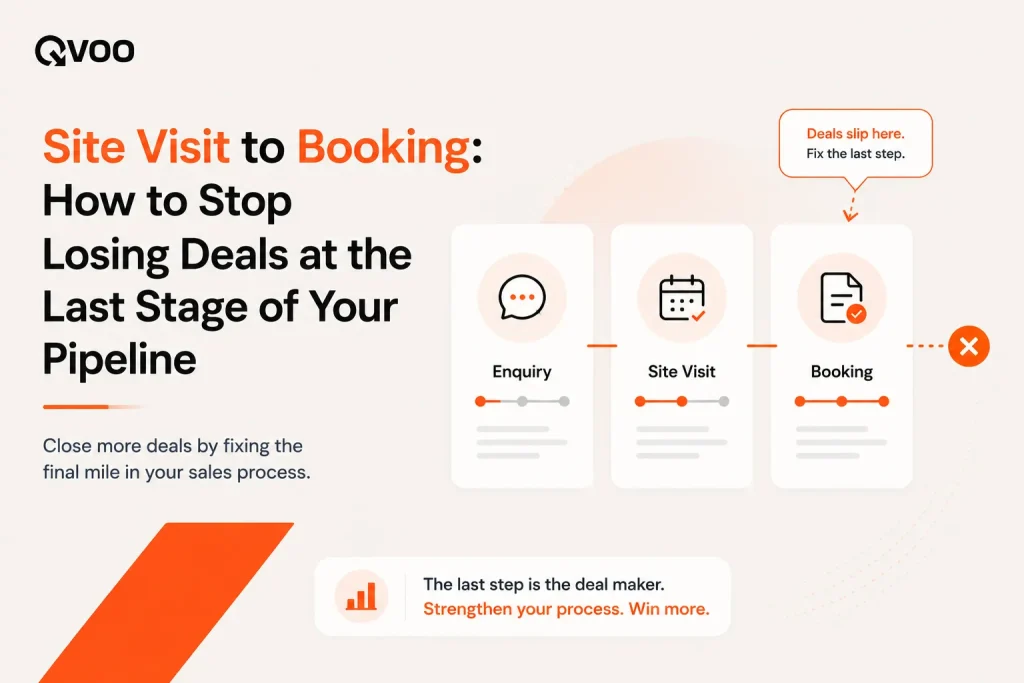
This is where most real estate deals quietly die. Not at the enquiry. Not at the first call. They die in the gap between the site visit and the booking the stage where the buyer is closest to saying yes, and the broker is busy chasing the next fresh lead.
You can have a full pipeline and still lose the deals that matter most. Improving your site visit to booking conversion is about plugging that one expensive leak the gap where ready buyers slip away.
Why the site visit is the most expensive stage to lose
Every stage of your pipeline has a cost. But the cost climbs the further a lead travels.
A cold enquiry that never picks up costs you a few minutes. A buyer who completed a site visit cost you a lot more: the follow-up calls to set it up, the travel, the agent’s time on site, and often a developer or channel-partner coordination. By the time someone physically visits a property, they have shown real intent. They are no longer “a lead.” They are a near-buyer.
So when a post-visit lead goes cold, you are not losing a name in a list. You are losing the most qualified opportunity in your pipeline and the money you already spent to get them there.
The hard part is that this drop-off is invisible. A missed enquiry shows up as a missed call. A lost post-visit buyer just… goes quiet. Nobody flags it. The lead sits at “Site Visit” in your records while the buyer signs somewhere else.
The four reasons deals stall after the site visit
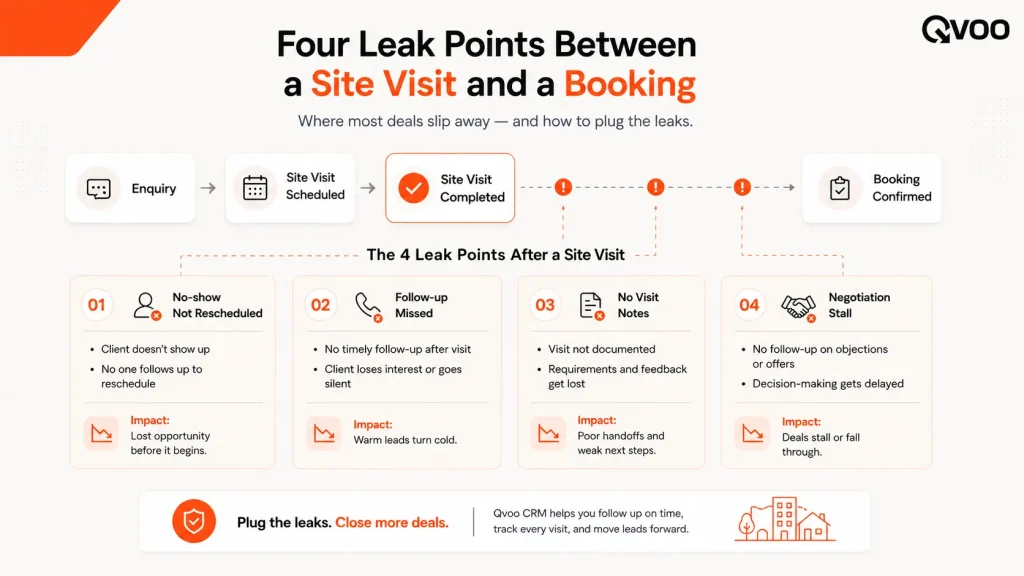
Across broker teams, the same four patterns cause most of the damage.
1. No-shows that never get rescheduled
A buyer confirms a Sunday 11 AM visit and doesn’t turn up. The agent waits, gets annoyed, and moves on. The visit is never rescheduled. A no-show is not a “no” it is usually a clash, a forgotten appointment, or cold feet. Treated right, a large share of no-shows can be re-booked. Treated as a dead end, they all become losses.
2. The follow-up that never happens
The visit goes well. The buyer says they’ll decide. Then nothing because there is no reminder telling the agent to call back on Tuesday. The deal depends on the agent’s memory, and memory loses to a busy week every time.
3. No record of what the buyer actually said
The agent who did the visit remembers the buyer wanted a higher floor and was worried about the loan. But that note lives in the agent’s head. When the buyer calls back two weeks later, a different team member picks up, knows nothing, and restarts the conversation from zero. The buyer feels like a stranger and walks.
4. The silent negotiation stall
The buyer is keen but stuck on price, or waiting on a family decision, or comparing two projects. Nobody is actively managing that hesitation. With no nudge, no fresh information, and no sense of urgency, the deal just drifts until it dies.
A practical playbook to improve site visit to booking conversion
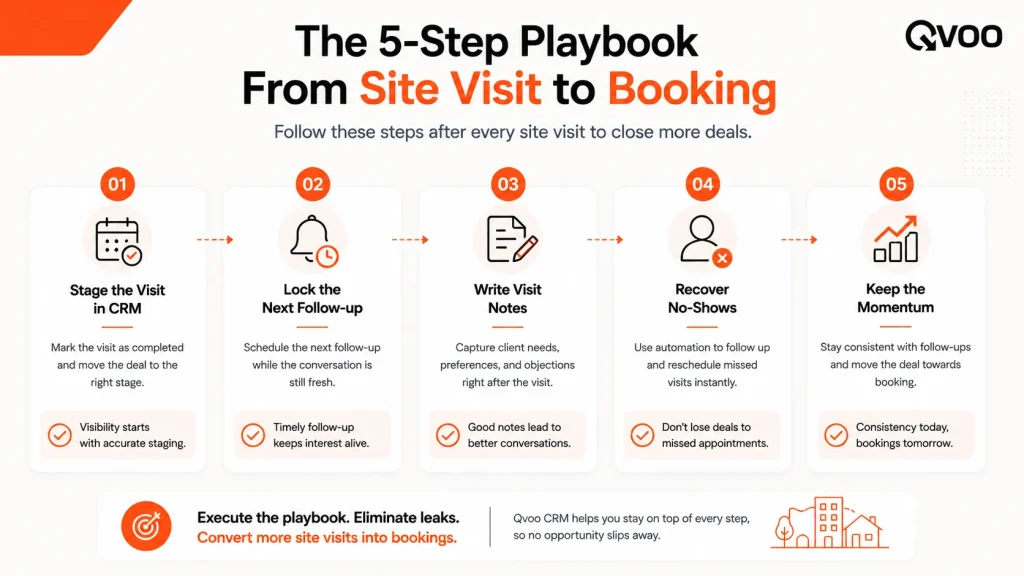
You don’t fix this with more hustle. You fix it with a simple, repeatable system that runs after every site visit. Here is the playbook.
Step 1: Treat the site visit as a stage, not an event
Most teams think of a site visit as a one-off appointment. Treat it instead as a stage in your pipeline with its own next action. The moment a visit is done, the lead should move to a clear stage “Visited,” “Negotiation,” or whatever your team calls it so everyone can see it is now in the closing zone and needs attention.
Step 2: Lock the follow-up before you leave the property
The best time to set the next step is while you are still standing in the flat. Agree a specific next action with the buyer a call, a price discussion, a second visit with the spouse and put it on the calendar then and there. A follow-up with no date is a follow-up that won’t happen.
Step 3: Write down what the buyer said, in one place
Capture the real signal while it is fresh: which floor, what budget worry, who else decides, what they compared it to. This note is the difference between a warm, personal next call and a cold restart. It should live on the lead’s record, not in one agent’s memory so anyone on the team can pick up the thread.
Step 4: Recover no-shows fast
When a visit is missed, reach out the same day with a friendly, low-pressure message offering two new slots. Same-day beats next-week every time. The longer a no-show sits, the colder the buyer gets.
Step 5: Keep the negotiation moving with a reason to talk
A hesitant buyer needs a nudge with substance a similar unit, a clearer price breakdown, an update on availability, a soft deadline tied to a real event. Each touch should give them something new, not just “any update?” Silence is what kills late-stage deals; momentum is what closes them.
A real example: the Sunday visit that almost slipped
Picture a mid-sized brokerage selling units in a new project. On Sunday, an agent shows a 3BHK to a couple. They love the layout but worry about the EMI and want the higher floor, which costs more.
The old way: the agent makes a mental note to “follow up sometime.” Monday is busy with three fresh portal leads. By the time anyone remembers the couple, it’s the following weekend, the urgency is gone, and they’ve booked elsewhere.
The systematic way: before leaving, the agent moves the lead to “Negotiation,” schedules a Tuesday follow-up call, and writes a note “Likes 3BHK, wants 12th floor+, worried about EMI, decision with wife by month-end.” On Tuesday the reminder fires. The agent calls back with a clear EMI breakdown and confirms a higher-floor unit is available. A second visit is booked for the wife. Within ten days, the unit is booked.
Same buyer. Same flat. The only difference is the system around the agent.
How Qvoo helps you close the gap
Qvoo CRM currently helps real estate teams manage enquiries, follow-ups, property leads, sales pipeline, and bookings from one place built on a scalable platform with a broader CRM vision for more industries in the future. The site-visit-to-booking stage is exactly where it earns its keep.
Here is how the playbook maps to real Qvoo features:
- Schedule and track site visits on the Calendar. Book a site visit against a lead and a specific property, set the date and time, and let the system schedule reminders so visits don’t get forgotten. The calendar shows pending and overdue follow-ups, so nothing quietly disappears.
- Capture the outcome the moment the visit ends. When you mark a site visit complete in Qvoo, you can record the outcome and notes and move the lead to the right stage in the same step. The buyer’s real signals get saved on the lead, not lost.
- Keep the whole story on one timeline. Every site visit, follow-up, note, and stage change is logged on the lead’s activity timeline. Any team member who opens that lead sees exactly what happened and what was promised so the callback is warm, not a cold restart.
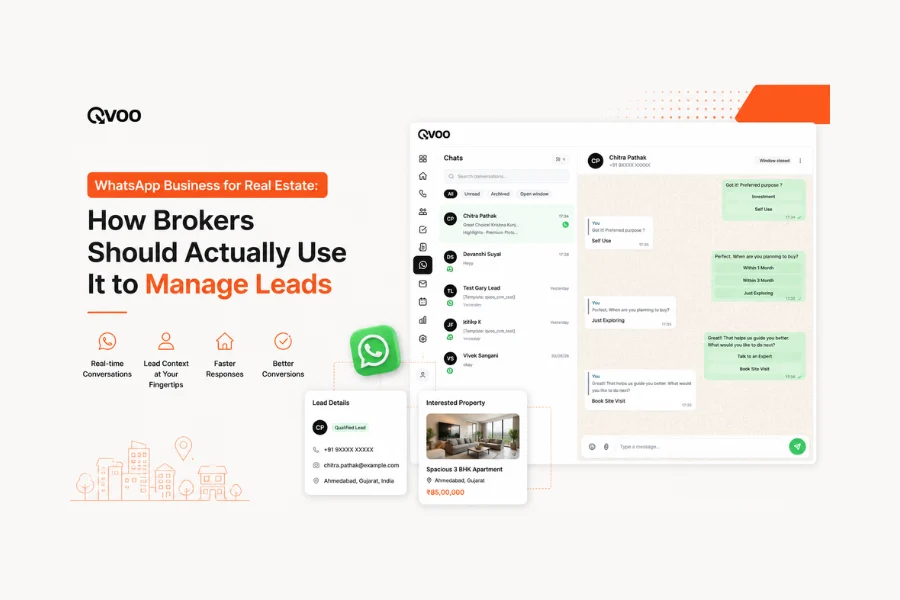
- Follow up on WhatsApp without losing time. Qvoo connects to WhatsApp Business so you can send quick, approved-template follow-ups and reach many buyers at once with bulk messaging to recover no-shows and keep negotiations alive where buyers actually reply.
- See where deals are stuck. Qvoo’s dashboard KPIs and reports let you watch your pipeline by stage and spot leads sitting too long after a visit so a manager can step in before the deal goes cold, instead of finding out after it’s lost.
The point isn’t more software. It’s that the follow-up no longer depends on one agent remembering. The system remembers for the whole team.
Conclusion
The site visit is the moment your buyer is closest to yes. Losing them there is the most expensive mistake in real estate sales and the most avoidable. Treat the visit as a stage, lock the next step before you leave, write down what the buyer said, recover no-shows fast, and keep the negotiation moving with a real reason to talk.
Do that consistently and your booking numbers move without a single extra lead.
If you want that follow-up to run on a system instead of on memory, see how Qvoo CRM keeps your site visits, notes, and reminders in one place. Book a demo and turn more visits into bookings.
Want to increase lead success rate?
Increase the lead success ratio with proper lead management and systematic follow-ups. Explore QVOO.
Frequently Asked Questions
What is a good site visit to booking conversion rate in real estate?
It varies by city, project, and price band, so treat any benchmark as a rough guide rather than a rule. What matters more is your own trend: track how many completed site visits turn into bookings each month, then work to improve that number. Most teams find the biggest gains come not from more visits but from better, faster follow-up after each one.
Why do buyers go cold after a site visit?
Usually it’s not a hard no. The common reasons are a missed or unrescheduled appointment, a follow-up that never happened, a price or loan worry nobody addressed, or a decision pending with family. Each of these is recoverable if someone is actively managing the lead instead of waiting for the buyer to call back.
How soon should I follow up after a site visit?
Set the next step before you even leave the property, and make the first follow-up quick ideally within a day or two while the visit is fresh. For a no-show, reach out the same day with two new time slots. Speed is the single biggest lever on late-stage conversion.
How do I stop losing site-visit notes between team members?
Keep notes on the lead’s record, not in an agent’s head or a personal chat. When every visit, note, and follow-up sits on one shared timeline, any team member can pick up the conversation exactly where it stopped which is what makes the callback feel personal instead of generic.
Can a CRM really improve booking conversion, or is it just record-keeping?
A CRM helps when it drives action, not just storage. The value is in scheduled reminders that fire on time, a clear pipeline stage that shows which deals are in the closing zone, and shared notes that keep follow-ups warm. Qvoo CRM brings site visits, follow-ups, notes, and WhatsApp into one place so the closing process doesn’t depend on memory.
What’s the difference between tracking a pipeline and reducing drop-off?
Tracking tells you where a lead is. Reducing drop-off is about acting on it making sure each post-visit lead has a clear next step, an owner, and a deadline. You can have perfect visibility and still lose deals if nobody is nudging the stalled ones forward.